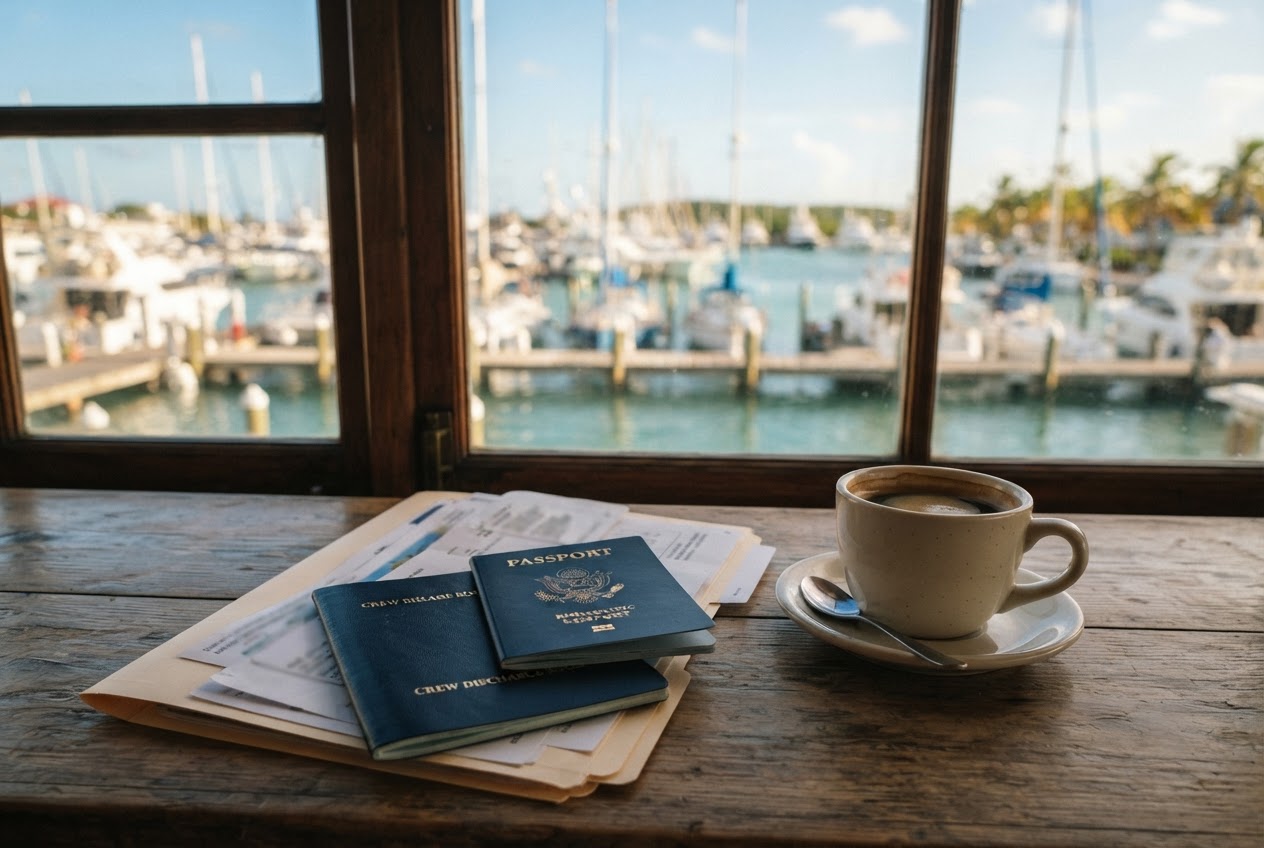
If you are not a US or Canadian citizen and you want to work on a private yacht that cruises in US waters (Florida, New England, the US Virgin Islands), you will almost certainly need a B1/B2 visa. It is the standard US visitor visa, and the B1 (business) part is the route the US State Department points private yacht crew towards. The C1/D “crew visa” is meant for commercial ships and airlines, and ESTA will not let you make your first US entry on board a private yacht. This guide explains why, what the application involves, what changed recently and how to walk into the embassy interview prepared.
This is general information for crew, not immigration or legal advice. US visa rules and consular practice change, so always confirm the current requirements on travel.state.gov and your local US embassy website before you apply.
Why the B1/B2 matters so much for yacht jobs
Every winter a large part of the superyacht fleet moves from the Mediterranean to Florida and the Caribbean, and hiring follows the boats. If you read our 2026–27 yacht season calendar, you will see that November to January is exactly when crew relocate to Fort Lauderdale and Antigua to look for work.
Many of those job adverts say “B1/B2 required” in the first line. Live listings on crew job boards such as YaCrew state it outright, and recruitment agency YPI CREW notes that a significant number of the jobs it receives ask for candidates who already hold one. In other words, the visa can decide whether your CV even gets read for a US-based boat.
B1/B2 vs C1/D: which visa do yacht crew need?
This is the most common point of confusion, and getting it wrong at the interview can lead to a refusal.
- B1/B2 is a non-immigrant visitor visa. B1 covers business visits, B2 covers tourism. The State Department’s crewmember visa page says that if you are crew on a private yacht sailing out of a foreign port that will cruise in US waters for more than 29 days, you do not qualify for the D crew visa and should apply for a B-1 instead.
- C1/D is the transit and crewmember visa for people working on commercial vessels and airlines. It comes with strict limits, including a shore-leave window of up to 29 days, which does not suit how yachts operate.
Industry guides explain the logic simply: a yacht has no fixed trading schedule, so the US treats it as a private means of transport, and private yacht crew are handled as business visitors rather than commercial seafarers. As the crew training company Quarterdeck puts it, for private yacht crew the real question is whether you qualify for a B1/B2, not whether a crew visa applies.
The ESTA trap: why the Visa Waiver Program is not enough
If you hold a passport from a Visa Waiver Program country (most EU countries, the UK, Australia and others), you can normally visit the US with ESTA. That does not mean you can join a yacht with it.
Under the Visa Waiver Program, travellers arriving by air or sea must come in on an approved “signatory carrier” (see CBP’s signatory carrier page). A private yacht is not one. So if your first entry into the US is on board a private yacht arriving from a foreign port, ESTA does not work and you need a visa.
There is a narrow route that Noonsite reported US Customs and Border Protection (CBP) confirmed in early 2026: an eligible Visa Waiver traveller who first enters the US on a commercial carrier may later arrive by private yacht within that admission. In practice this does not replace a B1/B2 for crew who want to work on a US-based yacht, because ESTA does not cover crewing. Treat it as a tourist rule, not a job plan.
What changed recently: apply where you live
For years, crew went “embassy shopping”, booking interviews in whichever country had the shortest wait or the friendliest track record with yachties. That has largely ended. On 6 September 2025 the State Department announced that non-immigrant visa applicants should schedule interviews in their country of nationality or residence. If you apply based on residence, you must be able to prove you live there, and people who apply elsewhere may find it harder to qualify and wait longer.
The Nautilus Federation flagged the impact on yacht crew directly: you can no longer pick which embassy to use. What this means for you: plan your application from home, months before you fly to Fort Lauderdale or Antigua. Check current appointment wait times on the State Department’s global visa wait times tool.
How much does a B1/B2 visa cost?
- Application (MRV) fee: 185 USD for B visas, paid before the interview and non-refundable even if you are refused. The State Department lists this on its fees for visa services page.
- Reciprocity (issuance) fee: some nationalities pay an extra fee when the visa is issued, and the validity of the visa (up to 10 years) also depends on your nationality. Check the reciprocity table for your country.
- Visa Integrity Fee: a 250 USD fee for most non-immigrant visas was written into US law in 2025. Reports differ on whether and where it is being collected yet, so check your embassy’s fee page when you book. Budget for it in case it applies.
On top of that, add travel to the embassy, photos and possibly a night in the city. It is a real cost, which is one more reason to apply once, properly prepared.
Step-by-step: how to apply
- Complete the DS-160 online form. Answer honestly and consistently: what you write here is what the officer will read during your interview.
- Pay the application fee through the official payment channel for your country and keep the receipt.
- Book the interview at the US embassy or consulate in your country of nationality or residence.
- Prepare your documents (see the checklist below).
- Attend the interview in person, answer clearly and wait for the decision. Do not book non-refundable flights until the visa is in your passport, as the State Department itself advises.
Documents to bring to the interview
- Valid passport and DS-160 confirmation page
- Fee payment receipt and a compliant photo if your embassy requires one
- Your STCW Basic Safety Training certificates and your ENG1 medical
- A letter from the yacht, its management company or a crew agency describing your role, the vessel and its itinerary, if you have one
- Seaman’s discharge book or proof of sea time, if you have any
- Evidence of ties to home: a residence, a lease, family, a return plan
- A printed copy of your yacht CV, so you can explain your experience and goals clearly
How to handle the interview
The interview is usually short. The officer wants to understand why you are travelling and to be satisfied that you will leave the US after your stay. Visitor visa refusals usually come down to that second point, known as Section 214(b).
- Be honest about what you do. Say you are (or want to be) crew on a foreign-flagged private yacht. Hiding the work is far riskier than explaining it.
- Use the right vocabulary. Crew agents quoted by SuperyachtNews and Yotspot have advised crew to describe the yacht as private and to avoid framing the job around “charter” or “commercial” work, which can push officers towards the C1/D category.
- Show you have a life to return to. A home address, family, a plan for the next few years: anything that shows the US is a workplace, not a relocation.
- Keep answers short and consistent with your DS-160.
One honest caveat: crew without a job yet sometimes struggle, because officers want to see the purpose of travel while many captains want to see the visa before hiring. SuperyachtNews has reported on exactly this catch-22. A letter from a crew agency or a confirmed daywork offer can help, and so can getting your paperwork and certificates in order first.
After you get the visa: entering the US correctly
- Enter on the B1 side if you are joining a yacht. Dockwalk explains that if you come in as a tourist (B2) and then join a boat, you may need to leave the country and re-enter under B1.
- Check your I-94. The length of each stay is set by the officer at the border, not by the visa’s expiry date. Look it up at CBP’s I-94 site after every entry and never overstay.
- A B1 is not a US work permit. It lets you work on board a foreign-flagged private yacht. It does not allow you to take shore-based jobs, and being paid into a US bank account has been flagged by immigration lawyers as something that can cause problems later.
Frequently asked questions
Can I get a B1/B2 visa before I have a yacht job?
Many crew do, and many US-based jobs expect you to already hold one. It can be harder without an employer letter, so bring as much evidence as you can of your training, your plans and your ties to home.
I’m from an EU country. Can I just use ESTA?
Not to join or crew a private yacht arriving in the US. ESTA requires arrival on a signatory carrier, and private yachts are not signatory carriers. For yacht work you should plan on a B1/B2.
Can I apply at an embassy in another country to get a faster appointment?
Since September 2025 the State Department expects you to apply in your country of nationality or legal residence. Applying elsewhere is likely to mean longer waits and a harder time qualifying.
Do I need a B1/B2 to work in the Mediterranean?
No. The B1/B2 only matters for US waters, including the US Virgin Islands. Europe has its own entry rules (Schengen), which depend on your nationality and the yacht’s flag. If you are aiming for a Med-only season first, the visa can wait.
How long is the visa valid?
Validity depends on your nationality under the reciprocity schedule, and can be up to 10 years. Each individual stay is set separately by CBP when you enter.
Get the rest of your application ready
A visa gets you into the country; your CV and approach get you the job. If you are planning a Florida or Caribbean search this winter, start with our guides on how to write a yacht CV and how to get a yacht job with no experience. If you want it done faster, the Yacht Job Application Kit gives you two ready-to-edit yacht CV templates and a 10-page Application Playbook. And before you hit the marinas in Fort Lauderdale, grab our free Dockwalking Checklist.

Leave a Reply